气动三联件安装维护全攻略:正确操作,延长设备使用寿命
气动三联件安装维护全攻略!详解安装步骤、注意事项及日常维护技巧,解决漏气、排水不畅、调压失灵等问题,规范操作延长设备寿命,降低气动系统维护成本。
详细介绍
气动三联件安装维护全攻略:正确操作,延长设备使用寿命
气动三联件作为气动系统的“气源净化中枢”,其安装规范度和维护及时性,直接影响整个气动系统的运行效率和设备使用寿命。很多企业虽然选对了适配的气动三联件,但因安装操作不规范、日常维护不到位,导致三联件出现漏气、排水不畅、调压失灵等问题,不仅影响生产进度,还增加了设备维护成本。今天,我们就详细讲解气动三联件的安装步骤、注意事项以及日常维护技巧,帮助大家正确操作、科学维护,让气动三联件长期稳定运行。
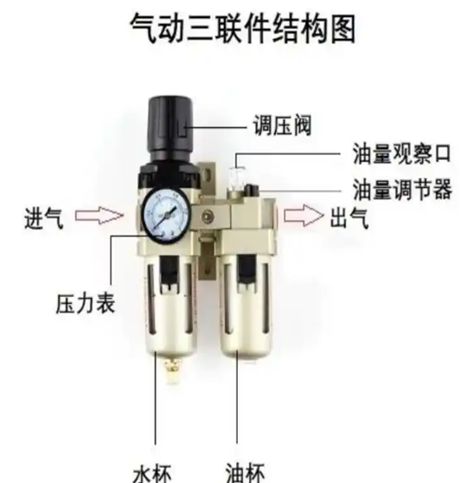
首先,我们先回顾气动三联件的核心构成,便于大家更好地理解安装和维护逻辑。气动三联件由过滤器、减压阀、油雾器三部分组成(无油型省略油雾器),三者各司其职、协同工作:过滤器负责过滤压缩空气中的水分、固体杂质,净化气源;减压阀负责将不稳定的空压机输出气压,调节至气动设备所需的稳定气压;油雾器负责将润滑油雾化后,随压缩空气输送至气动元件,减少元件磨损。三者的安装顺序固定,需严格按照“进气口→过滤器→减压阀→油雾器→出气口”的顺序安装,不可颠倒,否则会影响处理效果。
接下来,详细讲解安装步骤和注意事项。第一步,安装前的准备工作。先检查气动三联件的外观,确认无破损、无漏气痕迹,配件(如滤芯、密封圈、接头)齐全;检查安装位置是否符合要求,需选择通风、干燥、便于操作和维护的位置,远离高温、潮湿、腐蚀性环境,避免阳光直射,同时安装位置需靠近气动设备,缩短管路长度,减少气压损耗;准备好所需的安装工具,如扳手、螺丝刀等,确保工具适配接头规格。
第二步,管路连接与固定。按照“进气→过滤→减压→油雾”的顺序,将三联件与空压机管路、气动设备管路连接,连接时需确保接头密封严密,可在接头处缠绕密封胶带,避免漏气;连接过程中,力度要适中,不可过度拧紧,防止损坏接头和阀体;连接完成后,用扳手轻轻晃动接头,检查是否连接牢固,无松动现象。对于紧凑型三联件,可通过支架固定在设备支架上,确保安装牢固,避免设备运行时产生的振动导致三联件松动。
第三步,安装后的调试工作。调试是确保气动三联件正常工作的关键环节,不可省略。首先,打开空压机,让压缩空气进入三联件,观察过滤器的压力表,确认气压是否稳定;然后,缓慢调节减压阀的调节旋钮,根据气动设备的工作需求,将气压调节至合适范围(一般为0.1-0.8MPa),调节过程中需观察压力表的波动,确保气压稳定,无明显波动;若为有油型三联件,需向油雾器中加入适配的润滑油,油位控制在油标刻度线之间,避免油位过高或过低,影响润滑效果;最后,启动气动设备,观察三联件的运行状态,确认无漏气、排水正常、油雾均匀,设备运行平稳即可。
安装完成后,日常维护尤为重要,正确的维护能有效延长三联件的使用寿命,减少故障发生。日常维护主要包括以下几个方面:一是定期排水,过滤器底部的排水阀需定期打开,排放过滤出的水分和杂质,避免水分堆积导致滤芯堵塞、腐蚀阀体,一般每天排放1-2次,潮湿环境可增加排放次数;二是定期清洗或更换滤芯,滤芯长期使用后会积累大量杂质,导致过滤效率下降,需根据使用工况定期清洗,若滤芯破损或堵塞严重,需及时更换,一般每3-6个月更换一次,恶劣工况可缩短更换周期;三是检查油雾器油位,定期补充润滑油,确保润滑效果,同时注意润滑油的型号,需与气动元件适配,不可混用不同型号的润滑油;四是定期检查密封性能,观察接头和阀体连接处是否有漏气现象,若有漏气,及时拧紧接头或更换密封圈;五是定期检查减压阀,确保调压精准,若出现调压失灵,需及时检修或更换阀芯。
此外,还要注意一些常见的维护误区。很多用户在维护时,会随意拆卸三联件,导致内部零件损坏,因此,拆卸三联件时需按照说明书操作,避免盲目拆卸;部分用户为了节省成本,会使用劣质滤芯或润滑油,这会加速三联件的磨损,缩短使用寿命,建议选择与三联件适配的优质配件和润滑油;还有用户忽略排水环节,导致水分堆积,腐蚀阀体和滤芯,这也是导致三联件故障的常见原因。
总之,气动三联件的安装需规范操作,维护需及时到位,只有这样才能充分发挥其气源净化、稳压、润滑的作用,保障气动系统稳定运行,延长设备使用寿命,降低维护成本。掌握正确的安装和维护技巧,能让气动三联件更好地为生产服务,提升生产效率。
Complete Guide to Installation and Maintenance of Pneumatic Triple Units: Correct Operation to Extend Equipment Service Life
As the "air source purification center" of the pneumatic system, the standardization of installation and timeliness of maintenance of the pneumatic triple unit directly affect the operation efficiency of the entire pneumatic system and the service life of the equipment. Many enterprises have selected suitable pneumatic triple units, but due to irregular installation operations and inadequate daily maintenance, the triple units have problems such as air leakage, poor drainage, and pressure regulation failure, which not only affect the production progress but also increase the equipment maintenance cost. Today, we will detail the installation steps, precautions, and daily maintenance skills of the pneumatic triple unit to help everyone operate correctly and maintain scientifically, ensuring the long-term stable operation of the pneumatic triple unit.
First, let's review the core composition of the pneumatic triple unit to help everyone better understand the logic of installation and maintenance. The pneumatic triple unit is composed of three parts: a filter, a pressure reducing valve, and an oil mist lubricator (the oil-free type omits the oil mist lubricator). Each of the three parts performs its own duties and works together: the filter is responsible for filtering moisture and solid impurities in the compressed air to purify the air source; the pressure reducing valve is responsible for adjusting the unstable output pressure of the air compressor to the stable pressure required by the pneumatic equipment; the oil mist lubricator is responsible for atomizing the lubricating oil and delivering it to the pneumatic components along with the compressed air to reduce component wear. The installation order of the three parts is fixed and must be installed strictly in the order of "air inlet → filter → pressure reducing valve → oil mist lubricator → air outlet". It cannot be reversed, otherwise, the treatment effect will be affected.
Next, we will detail the installation steps and precautions. Step 1: Preparation before installation. First, check the appearance of the pneumatic triple unit to confirm that there is no damage or air leakage, and the accessories (such as filter elements, seals, and joints) are complete; check whether the installation position meets the requirements. It should be installed in a well-ventilated, dry position that is easy to operate and maintain, away from high temperature, humidity, and corrosive environments, avoiding direct sunlight. At the same time, the installation position should be close to the pneumatic equipment to shorten the pipeline length and reduce pressure loss; prepare the required installation tools, such as wrenches and screwdrivers, to ensure that the tools are suitable for the joint specifications.
Step 2: Pipeline connection and fixation. Connect the triple unit to the air compressor pipeline and the pneumatic equipment pipeline in the order of "air inlet → filtration → pressure reduction → oil mist". During connection, ensure that the joints are tightly sealed. Sealing tape can be wrapped around the joints to avoid air leakage; during the connection process, the force should be moderate, and it should not be over-tightened to prevent damage to the joints and valve body; after the connection is completed, gently shake the joints with a wrench to check whether they are firmly connected without loosening. For compact triple units, they can be fixed on the equipment bracket through a bracket to ensure firm installation and avoid loosening of the triple unit due to vibration generated during equipment operation.
Step 3: Commissioning work after installation. Commissioning is a key link to ensure the normal operation of the pneumatic triple unit and cannot be omitted. First, turn on the air compressor to let the compressed air enter the triple unit, observe the pressure gauge of the filter, and confirm whether the pressure is stable; then, slowly adjust the adjustment knob of the pressure reducing valve, and adjust the pressure to the appropriate range (generally 0.1-0.8MPa) according to the working needs of the pneumatic equipment. During the adjustment process, observe the fluctuation of the pressure gauge to ensure that the pressure is stable without obvious fluctuation; if it is an oil-type triple unit, add suitable lubricating oil to the oil mist lubricator, and control the oil level between the oil level scale lines to avoid too high or too low oil level affecting the lubrication effect; finally, start the pneumatic equipment, observe the operation status of the triple unit, and confirm that there is no air leakage, normal drainage, uniform oil mist, and stable operation of the equipment.
After installation, daily maintenance is particularly important. Correct maintenance can effectively extend the service life of the triple unit and reduce the occurrence of faults. Daily maintenance mainly includes the following aspects: first, regular drainage. The drain valve at the bottom of the filter should be opened regularly to discharge the filtered moisture and impurities, so as to avoid filter element blockage and valve body corrosion caused by moisture accumulation. Generally, it should be discharged 1-2 times a day, and the discharge frequency can be increased in humid environments; second, regular cleaning or replacement of the filter element. After long-term use, the filter element will accumulate a lot of impurities, leading to a decrease in filtration efficiency. It should be cleaned regularly according to the working conditions. If the filter element is damaged or severely blocked, it should be replaced in time. Generally, it should be replaced every 3-6 months, and the replacement cycle can be shortened under harsh working conditions; third, check the oil level of the oil mist lubricator, supplement lubricating oil regularly to ensure the lubrication effect, and pay attention to the model of the lubricating oil, which should be suitable for the pneumatic components, and different models of lubricating oil cannot be mixed; fourth, regularly check the sealing performance, observe whether there is air leakage at the joints and valve body connections, and if there is air leakage, tighten the joints or replace the seals in time; fifth, regularly check the pressure reducing valve to ensure accurate pressure regulation. If pressure regulation failure occurs, the valve core should be inspected or replaced in time.
In addition, attention should be paid to some common maintenance misunderstandings. Many users will disassemble the triple unit at will during maintenance, resulting in damage to internal parts. Therefore, when disassembling the triple unit, it should be operated in accordance with the manual to avoid blind disassembly; some users will use inferior filter elements or lubricating oil to save costs, which will accelerate the wear of the triple unit and shorten its service life. It is recommended to select high-quality accessories and lubricating oil suitable for the triple unit; some users ignore the drainage link, leading to moisture accumulation and corrosion of the valve body and filter element, which is also a common cause of triple unit failure.
In short, the installation of the pneumatic triple unit must be standardized, and the maintenance must be timely and in place. Only in this way can it give full play to its functions of air source purification, pressure stabilization, and lubrication, ensure the stable operation of the pneumatic system, extend the service life of the equipment, and reduce the maintenance cost. Mastering the correct installation and maintenance skills can make the pneumatic triple unit better serve production and improve production efficiency.
下一篇:没有了